Over the years there have been many wars fought. Some wars have made progress between us and other countries, but most of the wars fought were over greed. One country, person or group wants one thing and so doesn't the other side so they fight until one person gets what the other side want for example the French and Indian war and Pontiac's Rebellion.
People have always been greedy we see this in the French and Indian war both sided wanted total control of the fur trade neither side could just hand it over to the other side nor could they split the trade in half so they had a war that lasted over seven years fighting who would get the fur trade. The French and Indian war was not necessary for progress at all it was becuse back then people were greedy just like people are now.
The war in Iraq is just like the American Revolution war. Both the British and the Americans wanted the same thing and fought for it out of greed. We are in a war in Iraq right right now fighting over oil, oil compaines are rich now but they're charging even more for it. Oil and gas is a nesscitie for americans and they figure that if we need we'll pay as much as they can charge for it. This war is not making any progress at all between us and the middle east, we are in middle of a war because of greed. Owners of oil companies are greedy and that is why we are in this war.
Tuesday, June 17, 2008

Final Essay #1 What If ?
Valley Forge was when the patriots had no war tactic, we were dieing from hunger and disease. Soldiers were losing all hope of coming out of the war gaining anything. General Baron Steuben came and taught the patriots war tactic so they could fight. Nathaniel Green came and provided food, shelter,clothing for the soldiers so they could survive, Nathaniel Green also provided weapons for the soldiers so that they could fight. If Green and Steuben hadn't come then the patriots wouldn't have had a chance of gaining anything from the Revolution war. One because they would have kept running because they didn't know how to fight or because they died of hunger or disease
If one change could be made to history Steuben could have never come to teach the soldiers war tactic this is plausible because Steuben could have never gotten involved with the other party therefore he could have never met George Washington. The effect this could have changed in history is Britain would have won more battles because they had better war tactic. If Green hadn't come the soldiers may have died of either hunger or disease. significance of change today is with Steuben coming and teaching our soldiers tactic if her hadn't our army may not be as strong as it is today.
This event is important today because we need to be the same way as the soldiers that fought in valley forge never giving up during hunger, disease, defeat and death. Without common and learning tactic our army probably wouldn't be as strong as it today. Today would be different because other countries may not fear us as much as they do now because we wouldn't be as strong, we also may not be as emotionally strong and be under someone elses power because we gave up. Know our ancestors fought through death, hunger and disease gives us strenght today to fight through almost anything.
If one change could be made to history Steuben could have never come to teach the soldiers war tactic this is plausible because Steuben could have never gotten involved with the other party therefore he could have never met George Washington. The effect this could have changed in history is Britain would have won more battles because they had better war tactic. If Green hadn't come the soldiers may have died of either hunger or disease. significance of change today is with Steuben coming and teaching our soldiers tactic if her hadn't our army may not be as strong as it is today.
This event is important today because we need to be the same way as the soldiers that fought in valley forge never giving up during hunger, disease, defeat and death. Without common and learning tactic our army probably wouldn't be as strong as it today. Today would be different because other countries may not fear us as much as they do now because we wouldn't be as strong, we also may not be as emotionally strong and be under someone elses power because we gave up. Know our ancestors fought through death, hunger and disease gives us strenght today to fight through almost anything.
Monday, May 19, 2008
Book Portfolio on Night
In the book Night published in 1960 by Elie Wiesel the book is all about the journey and personal experiences of one person during the Holocaust. The author shows each step that he took place in during the Holocaust from being invaded by the Germans and forming a ghetto to being starved and working, seeing the ones you love die and at last sweet victory of beating Hitler and not dieing. The theme for the book Night is we can learn from our past so we don't repeat our mistakes. The significance of the theme is to show people that if we don't learn from the mistakes from the people before us what can happen.
The Thematic statement for the book Night by Elie Wiesel is to show the people that we can learn from our past mistakes in history and not repeat them, this is shown many times throughout the book. First throughout the book the Germans don't treat the Jews like humans ie. when they give them small rations of food, don't give them very many clothes and stick them in cattle carts like cows. In the beginning of the book the Jews have trust that the Germans aren't going to come for them or even harm them if they do come. The last thing we could learn from and not repeat is loosing faith just like the Jews did during the Holocaust for ie. Elie lost faith in God, why let bad things happen to good people, they lost faith in their family in friends. Elie wondered if his father was slowing him down so if he was dead would he be ahead of the game. This theme relates because when your not treated like human, you loose trust and faith therefore showing that if something like this ever happened again we might live longer knowing we can keep faith.
This theme is important now and has been through time. The Holocaust was a major genocide where about 6 million Jews were killed. The Jews weren't the only ones targeted during the Holocaust, Jehovah's witnesses, homosexuals and gypsies. Elie the author of Night wrote the book so that people would know of the tragic event and learn from the mistakes and not repeat them. America has learned from their mistakes but other countries haven't so they need make mistakes and learn from them. For example Rwanda which is a recent genocide that happened in the 90's is where the Hutu's tribe in Africa tried to take out the Tutsi's. 800,000 deaths happened in 100 days. We're supposed to learn from our mistakes like the holocaust. and yet Rwanda happened only 14years ago. Darfur which only happened in 2003 is massive genocide of women and children Many were kicked out of the country. 200,000 people died in Darfur because of disease, malnutrition and violence. Elie the author of Night wrote about his experiences. America has learned from the mistakes of the Holocaust, but many other countries haven't unfortunately so in order for genocide to stop, other countries must experience it for themselves and learn from their mistakes.
The theme in the book Night is to show that we need to learn from our past so we don't repeat our mistakes. Night by Elie Wiesel is all about the Holocaust the theme in the book is important because it shows that if we don't learn from our past there could be another big genocide within the Jews. The theme is important in history because we can learn from our past and not repeat the same mistake twice having another or multiple genocide's taking out big pieces of the population. Elie Wiesel shows the theme of the book very well, he talks about his own struggles through the Holocaust. For example the Germans not treating the Jews like humans, Among Elie and other Jews were tossed in cattle carts treated like cows and driven miles away for days. People loosing faith in not only God but the people that were around them Elie lost trust that his father was going to make and the rabbi felt like it was the end and they were never going get out. Everyone lost trust going from being oblivious and thinking the Germans weren't going to come and in the end thinking the Germans have every control over them. Elie lost trust in his friends and family when they started talking nonsense about dieing when they were so close to getting out of the concentration camps. It is important once again to understand the theme because if we don't learn from our past then history will keep repeating itself and we will never be able to learn anything.
The Thematic statement for the book Night by Elie Wiesel is to show the people that we can learn from our past mistakes in history and not repeat them, this is shown many times throughout the book. First throughout the book the Germans don't treat the Jews like humans ie. when they give them small rations of food, don't give them very many clothes and stick them in cattle carts like cows. In the beginning of the book the Jews have trust that the Germans aren't going to come for them or even harm them if they do come. The last thing we could learn from and not repeat is loosing faith just like the Jews did during the Holocaust for ie. Elie lost faith in God, why let bad things happen to good people, they lost faith in their family in friends. Elie wondered if his father was slowing him down so if he was dead would he be ahead of the game. This theme relates because when your not treated like human, you loose trust and faith therefore showing that if something like this ever happened again we might live longer knowing we can keep faith.
This theme is important now and has been through time. The Holocaust was a major genocide where about 6 million Jews were killed. The Jews weren't the only ones targeted during the Holocaust, Jehovah's witnesses, homosexuals and gypsies. Elie the author of Night wrote the book so that people would know of the tragic event and learn from the mistakes and not repeat them. America has learned from their mistakes but other countries haven't so they need make mistakes and learn from them. For example Rwanda which is a recent genocide that happened in the 90's is where the Hutu's tribe in Africa tried to take out the Tutsi's. 800,000 deaths happened in 100 days. We're supposed to learn from our mistakes like the holocaust. and yet Rwanda happened only 14years ago. Darfur which only happened in 2003 is massive genocide of women and children Many were kicked out of the country. 200,000 people died in Darfur because of disease, malnutrition and violence. Elie the author of Night wrote about his experiences. America has learned from the mistakes of the Holocaust, but many other countries haven't unfortunately so in order for genocide to stop, other countries must experience it for themselves and learn from their mistakes.
The theme in the book Night is to show that we need to learn from our past so we don't repeat our mistakes. Night by Elie Wiesel is all about the Holocaust the theme in the book is important because it shows that if we don't learn from our past there could be another big genocide within the Jews. The theme is important in history because we can learn from our past and not repeat the same mistake twice having another or multiple genocide's taking out big pieces of the population. Elie Wiesel shows the theme of the book very well, he talks about his own struggles through the Holocaust. For example the Germans not treating the Jews like humans, Among Elie and other Jews were tossed in cattle carts treated like cows and driven miles away for days. People loosing faith in not only God but the people that were around them Elie lost trust that his father was going to make and the rabbi felt like it was the end and they were never going get out. Everyone lost trust going from being oblivious and thinking the Germans weren't going to come and in the end thinking the Germans have every control over them. Elie lost trust in his friends and family when they started talking nonsense about dieing when they were so close to getting out of the concentration camps. It is important once again to understand the theme because if we don't learn from our past then history will keep repeating itself and we will never be able to learn anything.
Friday, May 16, 2008
Valley Forge Letter
My dearest sister Isabella,
The winter has been very cold and tough we've only been given fire cakes grilled on the grittle to eat along with water. We share a 16x4 foot long and walls 61/2 feet talll and a stone fire place and a cloth door with 12 men, the floors are dirt it's cold, damp and a very unhealthy place to sleep in. For a year we've been with Washington and runing away it seems like every living second along with being shot at. I tell you this because you are my on sister and I trust that you won't tell ma that things are going poorly. I know this would break her heart since the bad news of pa's death earlier in the war.
The whole time fighting we've only won one battle and that was at trenton crossing the delware river. I hate being in the war and all i want to do is come home to take care of you and ma. I hope that you have found a decent man that both pa and i would both like. Many men at Valley Forge have gotten sick from drink from the same stream that the soliders have gone to the bathroom in. Those of us who haven't gotten sick have been made to have vaccines. Genereal Nathanael Green is now the quartermaster and things are looking up for the war we are being taught new things to help us win more battles.
Isabella I think i'm going to try and stick it out for another 6 months becaue I hate the Britians so much that we're being taught the skills by Baron von Steuben a German whose a profesional solider he looks funny and can't speak english but we are learning so many skills that are need to kill the Britian's and rub it in their faces. I'm doing this only for myself, but for you and everyone at home and the fallen soliders that felt the same way I do. with all my love,
Noah
The winter has been very cold and tough we've only been given fire cakes grilled on the grittle to eat along with water. We share a 16x4 foot long and walls 61/2 feet talll and a stone fire place and a cloth door with 12 men, the floors are dirt it's cold, damp and a very unhealthy place to sleep in. For a year we've been with Washington and runing away it seems like every living second along with being shot at. I tell you this because you are my on sister and I trust that you won't tell ma that things are going poorly. I know this would break her heart since the bad news of pa's death earlier in the war.
The whole time fighting we've only won one battle and that was at trenton crossing the delware river. I hate being in the war and all i want to do is come home to take care of you and ma. I hope that you have found a decent man that both pa and i would both like. Many men at Valley Forge have gotten sick from drink from the same stream that the soliders have gone to the bathroom in. Those of us who haven't gotten sick have been made to have vaccines. Genereal Nathanael Green is now the quartermaster and things are looking up for the war we are being taught new things to help us win more battles.
Isabella I think i'm going to try and stick it out for another 6 months becaue I hate the Britians so much that we're being taught the skills by Baron von Steuben a German whose a profesional solider he looks funny and can't speak english but we are learning so many skills that are need to kill the Britian's and rub it in their faces. I'm doing this only for myself, but for you and everyone at home and the fallen soliders that felt the same way I do. with all my love,
Noah
Wednesday, April 30, 2008
William Franklin Research Essay

William Franklin was born in 1731 and was born in Philideliphia William died December 13 1813. William Franklin represented New Jersey. William Franklin is the son BenjaminFranklin.William helped his father conduct many of the experiments that he is famous for, for example the kite experiment with lightning. William was engaged to a woman named Elizabeth Graeme but while he was in England studing law he married and had a chiled name William Temple Franklin with Elizabeth Downes.
William Franklin was a loyalist to King George III. When William came home from England he became a Royal governor in New Jersey, while he was in office William signed the charter for the Queen college. William remained loyal to the king while his father sided with. George Washington. With son and father on different sides it strained the relationship. John Adams and Samuel Adams on the other hand were cousins and were on the same side.
One motivation that William Franklin had for sticking with the King was personal ambition. William Franklin was the Governor for New Jersey so for him living was good he was paid 1,800 pounds for the loss of all of his estates. William Franklin may have stayed a loyalist because he w thought England was on the wining side of the war. To be on the loosing side of the war like Thomas Paine and Thomas Jefferson would not be good for his appearance he had made with all of the people higher than him. Benjamin Franklin was William's father. Ben was a patriot during the war and was doing a great deal of leading on that side, William Franklin did a good job of resiting his fathers actions to get him to change sides.
William Franklin doesn't deserve anymore recognition then he already has. He did little things during the war but nothing major that stands out. If were not leaning about William Franklin in class is he that important to learn about?
Wednesday, April 9, 2008
Boston Masacre
Gentleman of the jury:
Capt. Preston is indeed innocent on the day that the fight broke out between Sentinal and the teenager, Preston was not around as the mobed formed and things were being thrown at the soldiers by spectators, the mob was shouting fire, fire, fire, fire was interperted as a house was on fire so the fire bell starts ringing, this caused a lot of comotion and the soliders began to fire even though the order was not given.
Who's to blame for the five people being killed during the fight between Sentinal and the teenage boy? There was a lot of comotion going on that day with people throwing sticks and snowballs. The mob was shouting different things like fire, and when that was said the bell for a house fire started ringing and then soliders started to fire their guns without the command of their captin. There were may testomonies to say that they saw preston say fire but it was indeed a dark night out and you can not clearly see someone lips moving or hear them correctly from 18ft away when there is fighting, yelling, and church bell going off.
There is not any real evidence that Capt. Preston ever said the word fire. So most people would say that capt. Prestons men are guilty, But many people were saying fire fire and with all of the comothion going on Prestons men could have eaisly gotten confused thinking another mans voice was Capt. Prestons. Capt. Preston and his men should not be hung for the acidental deaths that occured the day of the Boston Massacre.
Capt. Preston is indeed innocent on the day that the fight broke out between Sentinal and the teenager, Preston was not around as the mobed formed and things were being thrown at the soldiers by spectators, the mob was shouting fire, fire, fire, fire was interperted as a house was on fire so the fire bell starts ringing, this caused a lot of comotion and the soliders began to fire even though the order was not given.
Who's to blame for the five people being killed during the fight between Sentinal and the teenage boy? There was a lot of comotion going on that day with people throwing sticks and snowballs. The mob was shouting different things like fire, and when that was said the bell for a house fire started ringing and then soliders started to fire their guns without the command of their captin. There were may testomonies to say that they saw preston say fire but it was indeed a dark night out and you can not clearly see someone lips moving or hear them correctly from 18ft away when there is fighting, yelling, and church bell going off.
There is not any real evidence that Capt. Preston ever said the word fire. So most people would say that capt. Prestons men are guilty, But many people were saying fire fire and with all of the comothion going on Prestons men could have eaisly gotten confused thinking another mans voice was Capt. Prestons. Capt. Preston and his men should not be hung for the acidental deaths that occured the day of the Boston Massacre.
Tuesday, April 1, 2008
Quarter 4 Notes
Revolution and War
1763-1789
Revolution Notes
1763—Proclamation Act
The proclamation line is a divider that shows or tells where the Indians can have and the Britain's can't take, this line is the Appalachian mountains - Mississippi Mt's Indians Appalachian to ocean is the Britain's
1763-1789
Revolution Notes
1763—Proclamation Act
The proclamation line is a divider that shows or tells where the Indians can have and the Britain's can't take, this line is the Appalachian mountains - Mississippi Mt's Indians
 Appalachian to ocean is the Britain's
 1764—Grenville Acts (direct tax)
Sugar (molasses, wine)
Stamp
Quartering
Currency
Virtual/ Direct Representation
The Grenville acts were where the king taxed the most precious things to the colonist stamp & sugar. Quatering act was where soliders were placed in middle class ppls homes, currencey - only british pounds were to be used all colonies. English would only let ppl who had their best intrest and knew what they wanted to represent, Britian would put their best intrest in their hand
Sugar (molasses, wine)
Stamp
Quartering
Currency

Virtual/ Direct Representation
The Grenville acts were where the king taxed the most precious things to the colonist stamp & sugar. Quatering act was where soliders were placed in middle class ppls homes, currencey - only british pounds were to be used all colonies. English would only let ppl who had their best intrest and knew what they wanted to represent, Britian would put their best intrest in their hand

Paul Revere
John Hancock
Propaganda
Boycotts
Lobsters (Lobster-backs, Thomas Lobster)
The first time delegates were sent to discuss issues against Britian
1766—Declaratory Act
They take back all of the takes but declares they have the right to tax the colonies any way they want to.
1767—Townsend Acts (indirect tax)
Charles Townsend
Writs of Assistance (search warrants)
Revenue used to pay Royal officials in the colonies
Tea Act (glass, paper, paint) support British East India Company
The second attmept to tax the colonies, establishes the tea acts
John Hancock
Propaganda
Boycotts
Lobsters (Lobster-backs, Thomas Lobster)
The first time delegates were sent to discuss issues against Britian
1766—Declaratory Act
They take back all of the takes but declares they have the right to tax the colonies any way they want to.
1767—Townsend Acts (indirect tax)
Charles Townsend
Writs of Assistance (search warrants)
Revenue used to pay Royal officials in the colonies
Tea Act (glass, paper, paint) support British East India Company
The second attmept to tax the colonies, establishes the tea acts

1770—Boston Massacre
March 5, 1770
Local reaction (primarily)
5 dead colonists
John Adams defends British soldiers/5 exonerated-2 convicted
Convicted men discharged and thumbs branded
the picture influenced people to fight, Paul Revere carved the picture of the Boston massacre
1773—Boston Tea Party
November 30, 1773--Dartmouth sails into Boston Harbor
December 16, 1773--Tea dumped into harbor
340 chests of tea dumped (value of 10,000 British pounds)
English did the tea act and this made Britian Furious. The tea acts were a response of the Boston Massacre
1774—Intolerable Acts (Coercive Acts in Britain)
Close the port of Boston
Shut down Provincial and Town Governments
All offices appointed
This was an even bigger push back to the Enlish for dumping all of their tea into the water. This was a harsh response
Named General Thomas Gage as Governor
Gave all western lands north of the Ohio R. to Quebec, allowed Catholic Church to practice
1774—1st Continental Congress
September to October (7 weeks)
Carpenter’s Hall, Philadelphia
New England—John Adams, Paul Revere, Silas Deane
Virginia—Washington, Patrick Henry, Peyton Randolph, Richard Henry Lee
Pennsylvania—John Dickenson, Joseph Galloway (Plan for American council under Parliament, to avoid war)
New York—John Jay, James Duane
Maryland—Samuel Chase (future Supreme Court Justice), Charles Carroll (richest man in Maryland, Catholic)
Declaration of Rights—rejects Parliamentary authority over internal colonial affairs, colonies manage own defense, united aid to Boston if Intolerable Acts continue, absolute boycott of British goods to be enforced rigidly
Everyone came together to decide what to do about the intolerable acts
1775— January
William Pitt urges Parliament to withdraw troops from America because the idea of managing the colonies through force was “too ridiculous to take up a moment of your lordships’ time”
March 5, 1770
Local reaction (primarily)
5 dead colonists
John Adams defends British soldiers/5 exonerated-2 convicted
Convicted men discharged and thumbs branded
the picture influenced people to fight, Paul Revere carved the picture of the Boston massacre
1773—Boston Tea Party
November 30, 1773--Dartmouth sails into Boston Harbor
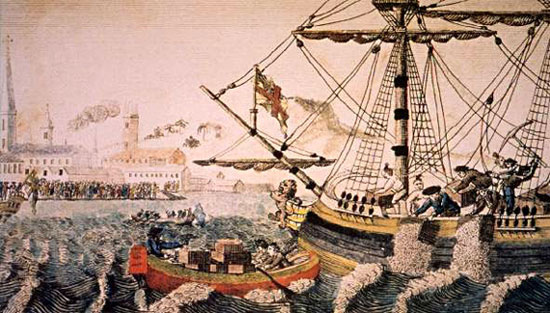
December 16, 1773--Tea dumped into harbor
340 chests of tea dumped (value of 10,000 British pounds)
English did the tea act and this made Britian Furious. The tea acts were a response of the Boston Massacre
1774—Intolerable Acts (Coercive Acts in Britain)
Close the port of Boston
Shut down Provincial and Town Governments
All offices appointed
This was an even bigger push back to the Enlish for dumping all of their tea into the water. This was a harsh response
Named General Thomas Gage as Governor

Gave all western lands north of the Ohio R. to Quebec, allowed Catholic Church to practice
1774—1st Continental Congress
September to October (7 weeks)
Carpenter’s Hall, Philadelphia
New England—John Adams, Paul Revere, Silas Deane
Virginia—Washington, Patrick Henry, Peyton Randolph, Richard Henry Lee
Pennsylvania—John Dickenson, Joseph Galloway (Plan for American council under Parliament, to avoid war)
New York—John Jay, James Duane
Maryland—Samuel Chase (future Supreme Court Justice), Charles Carroll (richest man in Maryland, Catholic)
Declaration of Rights—rejects Parliamentary authority over internal colonial affairs, colonies manage own defense, united aid to Boston if Intolerable Acts continue, absolute boycott of British goods to be enforced rigidly
Everyone came together to decide what to do about the intolerable acts
1775— January
William Pitt urges Parliament to withdraw troops from America because the idea of managing the colonies through force was “too ridiculous to take up a moment of your lordships’ time”
Don't go to war because it's expspensive. he's english nobody listens and later when they look back on the war the wished that they had listened.
1775—April 19 Lexington and Concord
Gen. Gage sends 700 men to Concord to seize the powder supplies
Paul Revere and William Dawes raise alarm the night before
Town of Lexington is on the way to Concord
Minutemen are assembled on the town common
“Shot heard round the world”
18 colonials killed and the rest run away
British march on to Concord and find the munitions were moved overnight
Minutemen ambush the British the whole way back to Boston
430 Redcoats make it back to Boston
30,000 Colonists surround Boston
1775—April 19 Lexington and Concord
Gen. Gage sends 700 men to Concord to seize the powder supplies
Paul Revere and William Dawes raise alarm the night before
Town of Lexington is on the way to Concord
Minutemen are assembled on the town common
“Shot heard round the world”
18 colonials killed and the rest run away
British march on to Concord and find the munitions were moved overnight
Minutemen ambush the British the whole way back to Boston
430 Redcoats make it back to Boston
30,000 Colonists surround Boston
The first battle of the war and the patriots hid ther stuff so the British never saw it
1775—May
Gen. Howe, Gen. Clinton, Gen. Burgoyne
5,000 British troops
Ethan Allen, “Green Mountain Boys” seize Fort Ticonderoga
Henry Knox uses canon to lay siege on Boston
Benedict Arnold (Connecticut) takes Fort Crown Point to impede an invasion from Canada
1775—May 10, 2nd Continental Congress
Sam Adams pushes for Independence
John Dickenson (Penn.) urges restraint
Agree to form Colonial Army
Delegates unanimously agree to Washington as Commander of Continental Army (John Adams suggestion)
John Adams is voting for the war with the english to happen and the nominate George Washington.
1775—June 17, “Battle of Bunker Hill”
Actually fought on Breed’s Hill
Gen. Howe leads assault without canon support (his canon had been matched with wrong-sized cannonballs [Amherst at Ticonderoga])
Militia waited to within 30 yards (some say 15 yards)
Militia target British officers
Militia ran extremely low on ammunition
On the third assault, led by Gen. Howe, British troops overtake the colonial position
Britain losses almost 1000 men (about half the attacking force)
Colonials lose about 500 men
1775—June 17, “Battle of Bunker Hill”
Actually fought on Breed’s Hill
Gen. Howe leads assault without canon support (his canon had been matched with wrong-sized cannonballs [Amherst at Ticonderoga])
Militia waited to within 30 yards (some say 15 yards)
Militia target British officers
Militia ran extremely low on ammunition
On the third assault, led by Gen. Howe, British troops overtake the colonial position
Britain losses almost 1000 men (about half the attacking force)
Colonials lose about 500 men

Bristsh win but we kill twice as many men as the British men did
1776—January, Common Sense
Written by Thomas Paine
120,000 copies sold in three months
1776—March
Gen. William Howe evacuates Boston
July 2, lands in Staten Island, New York (Loyalist base)
1776—Declaration of Independence
June 7, Richard Henry Lee (Virginia) introduces legislation to declare independence from Britain
Before voting on Lee’s proposal Congress appoints five-man committee to draft a formal Declaration of Independence (Thomas Jefferson, 33, does most of the writing)
June 28, Declaration presented to Congress
July 2, Congress approves Lee’s legislation to declare the United States of America independent of Great Britain
July 4, Congress officially adopts the Declaration of Independence
The Declaration intended to:
Undermine loyalty to King George III
Outline basic principles of representative government
Establish the “right” of rebellion
War
1776—January, Common Sense
Written by Thomas Paine
120,000 copies sold in three months
1776—March
Gen. William Howe evacuates Boston
July 2, lands in Staten Island, New York (Loyalist base)
1776—Declaration of Independence
June 7, Richard Henry Lee (Virginia) introduces legislation to declare independence from Britain
Before voting on Lee’s proposal Congress appoints five-man committee to draft a formal Declaration of Independence (Thomas Jefferson, 33, does most of the writing)
June 28, Declaration presented to Congress
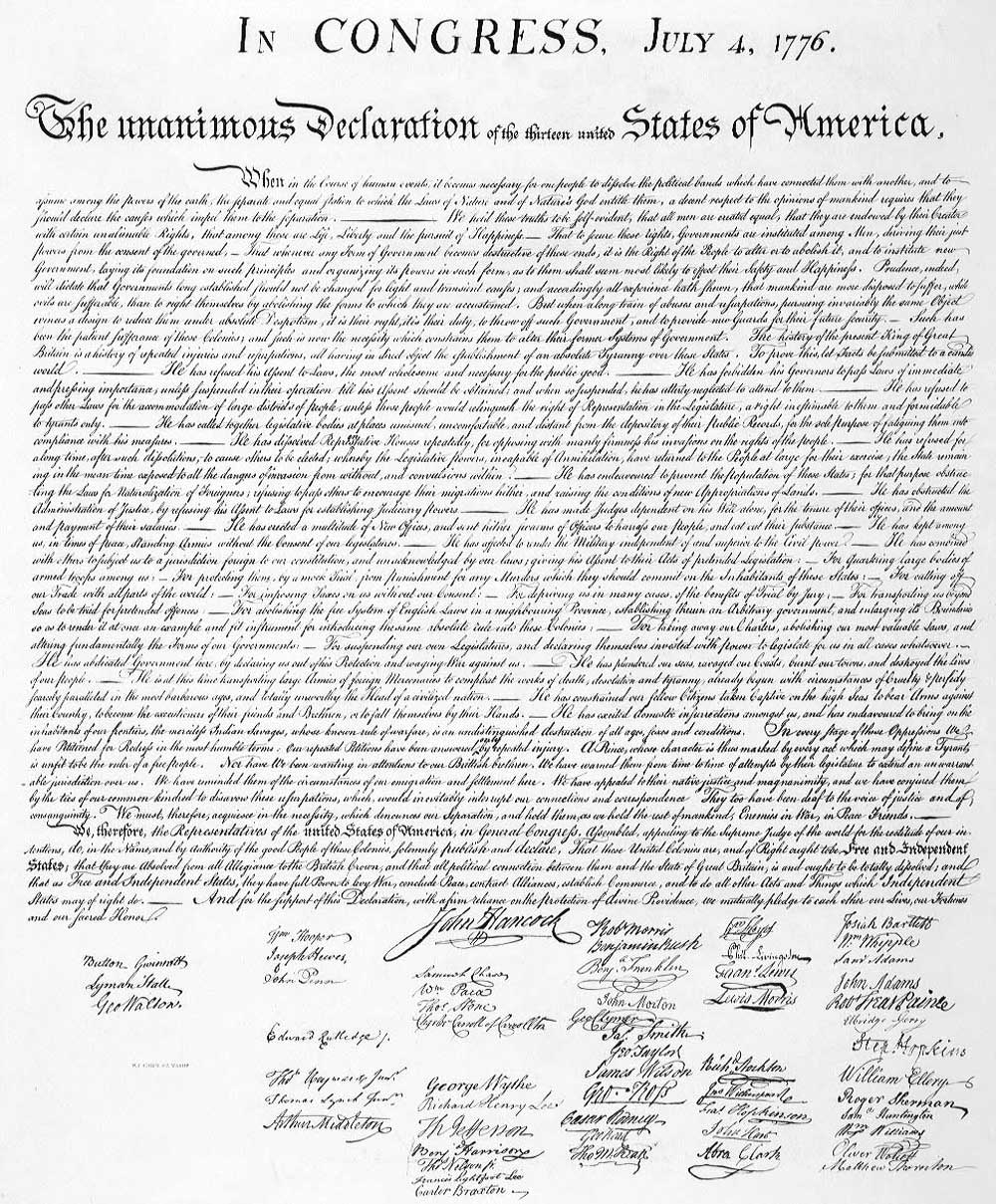
July 2, Congress approves Lee’s legislation to declare the United States of America independent of Great Britain
July 4, Congress officially adopts the Declaration of Independence
The Declaration intended to:
Undermine loyalty to King George III
Outline basic principles of representative government
Establish the “right” of rebellion
War
Thomas Paine wrote common sense
1776—August, Brooklyn Heights, New York
Largest Naval group Britain will launch until the 20th century
British victory, city falls to England
As winter came “sunshine patriots” left the American Army
Initial colonial enlistments due to expire
1776—December, Battle of Trenton
Howe believes war almost won
1,400 Hessians stationed at Trenton
Colonel Rall (Hessian) builds no fortifications
Washington “Crosses the Delaware” Christmas night
2,500 men; 18 artillery guns
Surprise attack at dawn
106 Hessians killed, 918 captured
No colonial casualties
Washington retreats in secret to avoid Gen. Cornwallis counter-attack
1776—August, Brooklyn Heights, New York
Largest Naval group Britain will launch until the 20th century
British victory, city falls to England
As winter came “sunshine patriots” left the American Army
Initial colonial enlistments due to expire
1776—December, Battle of Trenton
Howe believes war almost won

1,400 Hessians stationed at Trenton
Colonel Rall (Hessian) builds no fortifications
Washington “Crosses the Delaware” Christmas night
2,500 men; 18 artillery guns
Surprise attack at dawn
106 Hessians killed, 918 captured
No colonial casualties
Washington retreats in secret to avoid Gen. Cornwallis counter-attack
George washington was almost caught by the British but escaped capture by running though the fog
1777—January, Princeton
Washington ambushes British troops
Colonial victory establishes this will not be a quick war for Britain
1777—September-October, Saratoga
Gen. Burgoyne plans a three-prong attack on colonials at Albany
Plan does not consider the terrain, forcing British troops to march through swamps, lakes, hills and forests full of rebels
Two of the three “prongs” never arrive (Howe goes to Philadelphia instead, St. Leger retreats to New York afraid of Benedict Arnold)
Sept. Burgoyne crosses Hudson River
Oct. 17, Burgoyne surrenders
Establishes American Army as real threat
Helps secure open French Alliance
Turning Point of the War
A minor victory for Washington, ambush on British
1777—January, Princeton
Washington ambushes British troops
Colonial victory establishes this will not be a quick war for Britain
1777—September-October, Saratoga
Gen. Burgoyne plans a three-prong attack on colonials at Albany
Plan does not consider the terrain, forcing British troops to march through swamps, lakes, hills and forests full of rebels
Two of the three “prongs” never arrive (Howe goes to Philadelphia instead, St. Leger retreats to New York afraid of Benedict Arnold)
Sept. Burgoyne crosses Hudson River
Oct. 17, Burgoyne surrenders
Establishes American Army as real threat
Helps secure open French Alliance
Turning Point of the War

A minor victory for Washington, ambush on British
1777-1778—Winter at Valley Forge
Under-funded troops
Low morale
10,000+ troops
4,000 troops listed as “unfit for duty” due to poor supplies (boots, blankets, coats, etc.)
2,500 troops die of disease (typhus, typhoid fever, dysentery, pneumonia)
George Washington mentioned a lack of shoes so severe that the men's "marches might be tracked by the blood from their feet”
Local farmers would sell produce to Brits who could pay cash
Under-funded troops
Low morale
10,000+ troops
4,000 troops listed as “unfit for duty” due to poor supplies (boots, blankets, coats, etc.)
2,500 troops die of disease (typhus, typhoid fever, dysentery, pneumonia)
George Washington mentioned a lack of shoes so severe that the men's "marches might be tracked by the blood from their feet”
Local farmers would sell produce to Brits who could pay cash
Green came in and started bring in supplies and food for soliders, Steuben started to teach us war tactics so that we could win some battles.
1779—February, Vincennes
1780—August, Camden
1780—October, Kings Mountain
1781—October, Yorktown
British Gen. Cornwallis
American Gen. Washington (also “Mad” Anthony Wayne, Baron von Steuben)
French Gen. Rochambeau (also Marquis de Lafayette)
Essentially a French Naval victory
Last significant battle of the war
We suronded the British from the sea and we bombed them for 9 straight days.
1783—Sept. 3, Treaty of Paris
Britain recognizes American independence
America gets all land from Atlantic coast to Miss. River, Great Lakes to Florida
Fishing rights to the Gulf of Saint Lawrence and off the coast of Newfoundland
America must pay debts to Britain
American congress would “earnestly recommend” all Loyalist property returned (States ignore this request)
We were in Paris when we signed the treaty we negotiated with Britain we got the first two items and have to give Britain the last two.
1780—August, Camden
1780—October, Kings Mountain
1781—October, Yorktown
British Gen. Cornwallis
American Gen. Washington (also “Mad” Anthony Wayne, Baron von Steuben)

French Gen. Rochambeau (also Marquis de Lafayette)
Essentially a French Naval victory
Last significant battle of the war
We suronded the British from the sea and we bombed them for 9 straight days.
1783—Sept. 3, Treaty of Paris
Britain recognizes American independence
America gets all land from Atlantic coast to Miss. River, Great Lakes to Florida
Fishing rights to the Gulf of Saint Lawrence and off the coast of Newfoundland
America must pay debts to Britain
American congress would “earnestly recommend” all Loyalist property returned (States ignore this request)
We were in Paris when we signed the treaty we negotiated with Britain we got the first two items and have to give Britain the last two.
Subscribe to:
Posts (Atom)